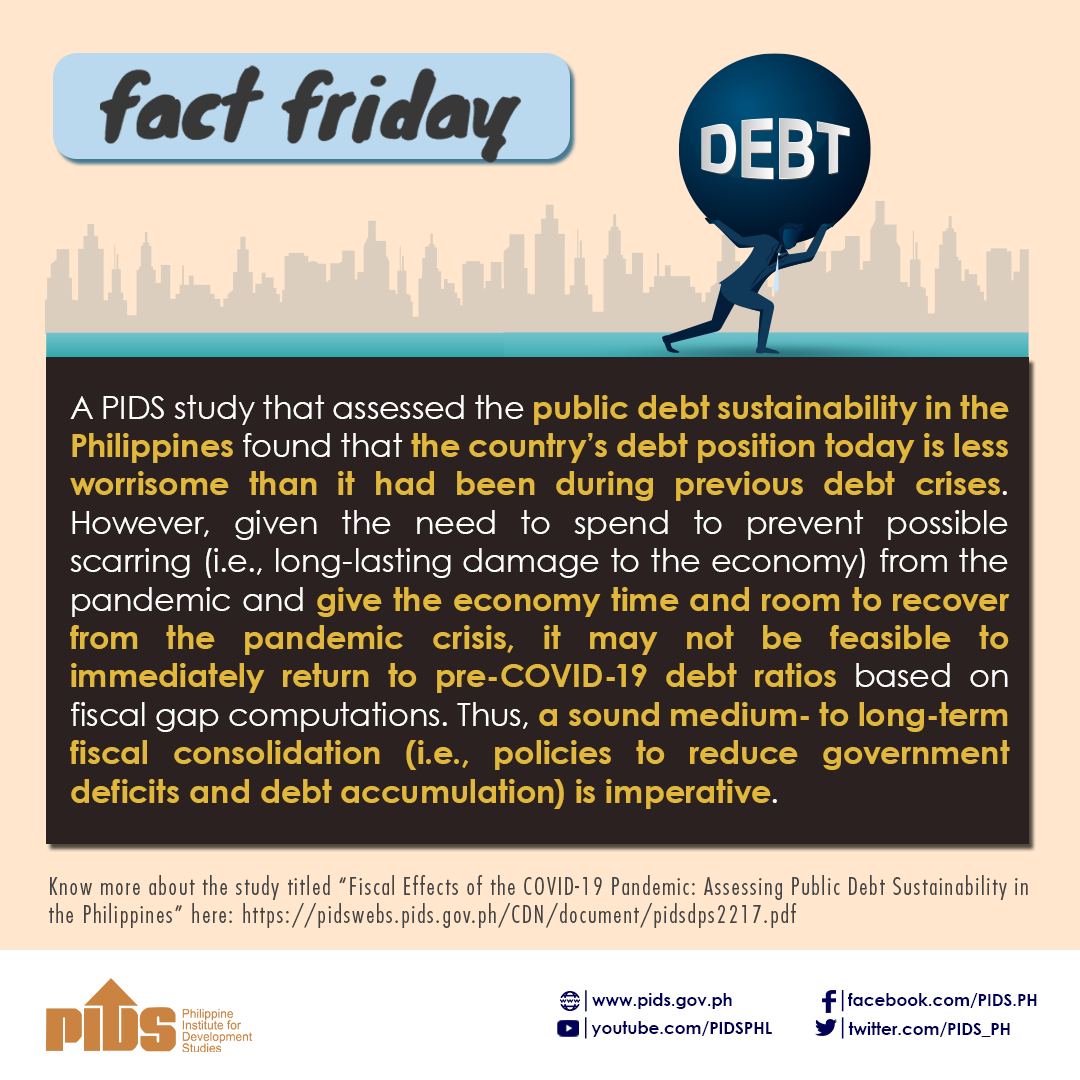
This paper examines whether the current level of debt in the country, given the national government’s fiscal policy and plans, remains on a sustainable path. By the end of 2021, a year after the peak of the public health and economic crisis brought about by the COVID-19 pandemic, the country’s debt-to-gross domestic product (GDP) ratio had already climbed to 60.4 percent, over 20 percentage points above pre-pandemic levels and slightly above the government’s indicative cap. In 2022, the debt was recorded at 60.9 percent of GDP. Several empirical exercises were performed in this paper to investigate the country’s fiscal solvency, including (1) providing a historical decomposition of public debt, (2) tracking the evolution of the debt-to-GDP ratio over the next half-decade through standard debt sustainability analysis, (3) computing the fiscal gap to shed light on the fiscal adjustments needed to bring the country to more comfortable debt levels, and (4) estimating fiscal reaction functions for the Philippines and developing ASEAN-5 economies to see how fiscal policy will likely respond to debt and other relevant macroeconomic conditions. The results suggest that the country’s debt position today is less worrisome than during previous debt crises, and that the debt-to-GDP ratio will remain manageable despite peaking above 65 percent over the next couple of years. Given the need to spend to prevent possible scarring from the pandemic and provide the economy with time and room to recover from the pandemic crisis, it may not be feasible to return immediately to pre-COVID-19 debt ratios, based on fiscal gap computations. This underscores the need for a sound medium- to long-term fiscal consolidation plan to anchor sentiments. Meanwhile, fiscal reaction functions for the Philippines and similar economies in the region indicate responsible fiscal policy that guarantees fiscal solvency. This presupposes, however, the absence of major fiscal policy reversals, especially of hard-won fiscal reforms since the mid-1980s.